Top 10 High Power Gear Motor Types for Buyers
Selecting a High Power Gear Motor is a practical decision with long-term consequences. The wrong ratio can leave a conveyor slow, hot, and costly to operate. The right unit can deliver steady torque through demanding shifts. The U.S. Department of Energy’s motor-systems guidance estimates that motor-driven systems use about 70% of industrial electricity. That figure covers more than gear motors, but it shows why efficiency deserves close attention.
This guide compares ten common types, including helical, bevel, planetary, worm, and cycloidal gear motors. Each design handles torque, speed, space, and shock loads differently. A compact planetary unit may suit a tight machine frame. A helical model may offer quiet, efficient operation in continuous service. Buyers should also check starting torque, duty cycle, mounting position, lubrication needs, and service access. Small details matter. A nameplate alone cannot predict performance in a real installation.
IEC 60034 efficiency classifications can help buyers assess motor efficiency, while manufacturer curves and application data clarify gearbox behavior. Ask suppliers for rated output torque, thermal limits, backlash, and test conditions. Compare like with like. Industry data has limits; published efficiency figures may not reflect frequent starts, poor alignment, or heavy dust. That is worth remembering. No type is best for every machine, and selection often involves trade-offs. The following overview gives buyers a grounded starting point, not a substitute for engineering review.
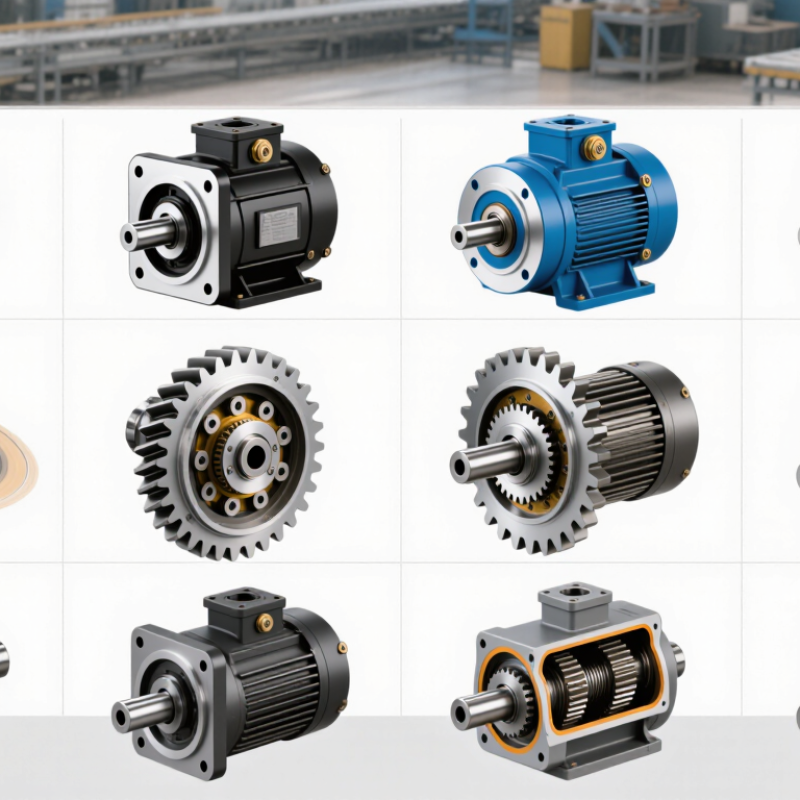
What Defines a High-Power Gear Motor?
A high-power gear motor is not defined by wattage alone. There is no universal cutoff. Its suitability depends on the torque and speed required at the machine’s output shaft. A unit delivering high torque at low speed may serve a demanding conveyor better than a faster motor with a higher nameplate rating. Check whether the listed power is input or output power, and confirm the operating point against the application.
The gearbox converts motor speed into usable output torque, but it also introduces losses and heat. Gear ratio, gear type, bearing capacity, and lubrication all affect performance. For example, a motor driving a loaded mixer may face repeated starts and changing resistance. Its duty cycle and peak starting torque matter as much as its rated power. A rating alone can be misleading.
Buyers should also consider the load profile, ambient temperature, mounting position, and available cooling. Continuous operation in a warm, dusty area can expose weaknesses that a short test will miss. Look for clear data on service factor, efficiency, thermal limits, and permitted overload duration. Then compare those values with measured or well-estimated operating conditions. Even experienced buyers can give too much weight to kilowatts; I would double-check the torque and duty assumptions before selecting a unit.
Top 10 High Power Gear Motor Types for Buyers - What Defines a High-Power Gear Motor?
| No. | Gear Motor Type | Typical Shaft Arrangement | Key Strengths | Buyer Considerations | Common Industrial Uses |
|---|---|---|---|---|---|
| 1 | Inline Helical | Input and output shafts are coaxial. | Smooth, quiet operation and good efficiency make this a versatile choice for continuous-duty applications. | Check output torque, thermal capacity, service factor, mounting position, and allowable radial and axial loads. | Conveyors, mixers, pumps, and general material-handling equipment. |
| 2 | Parallel-Shaft Helical | Parallel input and output shafts, commonly in a compact housing. | Helical gearing supports smooth transmission and is well suited to higher loads and continuous operation. | Confirm shaft orientation, housing dimensions, bearing-load limits, and whether a foot, flange, or shaft-mounted arrangement is needed. | Conveyors, bulk-material handling, crushers, and industrial process machinery. |
| 3 | Bevel-Helical | Usually right-angle input and output shafts. | Combines a bevel gear stage for changing shaft direction with helical stages for reduction; suitable for demanding industrial drives. | Review the required ratio, mounting orientation, operating loads, and space available around the drive. | Heavy conveyors, mixers, mills, and material-processing equipment. |
| 4 | Planetary | Often coaxial input and output shafts; other configurations are available. | High torque density and a compact design; multiple planet gears share the load. | Assess shock loading, backlash requirements, duty cycle, lubrication, and the radial or axial loads on the output. | Hoists, winches, mobile machinery, indexing equipment, and compact high-torque drives. |
| 5 | Worm | Typically right-angle shafts that do not intersect. | Can provide substantial speed reduction in a compact layout and may offer a quiet drive. | Efficiency can be lower than that of many helical designs, particularly at higher ratios. Check heat dissipation and do not assume the drive is self-locking. | Elevators, gates, positioning systems, and selected low-speed drives. |
| 6 | Helical-Worm | Generally right-angle output, with helical and worm stages combined. | Offers a compact right-angle arrangement with more design flexibility than a single-stage worm unit. | Compare total efficiency, temperature rise, ratio, and continuous output torque against the application’s duty cycle. | Packaging machinery, conveyors, mixers, and general process equipment. |
| 7 | Cycloidal | Often coaxial or right-angle, depending on the design. | Can deliver high reduction in a compact package and is commonly selected where shock loads and durability matter. | Check backlash, vibration, output-bearing capacity, maintenance needs, and the suitability of the design for continuous duty. | Robotics, feeders, mixers, conveyors, and machinery subject to impact loading. |
| 8 | Spur | Usually parallel shafts. | Simple gear geometry and straightforward construction; useful where cost and ease of maintenance are priorities. | Compared with helical gearing, spur gears can be noisier and engage less smoothly, especially at higher speeds or loads. | Low- and moderate-speed machinery, basic reducers, and equipment with intermittent duty. |
| 9 | Hypoid | Right-angle shafts with an offset between the shaft centerlines. | Provides a compact right-angle drive and can support smooth power transmission when correctly designed and lubricated. | Use the specified lubricant and verify thermal performance, load rating, and suitability for the required operating hours. | Selected vehicle, mobile-equipment, and compact right-angle drive applications. |
| 10 | Bevel | Usually intersecting shafts, often arranged at a right angle. | Changes the direction of power transmission; spiral-bevel designs generally run more smoothly than straight-bevel designs. | Specify the shaft angle, rotation direction, ratio, load profile, and required noise and efficiency performance. | Right-angle drives, conveyors, packaging machinery, and specialized industrial equipment. |
What defines a high-power gear motor? There is no universal power threshold. Buyers should evaluate rated motor power together with output torque, output speed, duty cycle, starting and peak loads, thermal capacity, and the gearbox service factor. A suitable unit must meet the application’s continuous and transient requirements, not just its nominal power figure.
FAQS
There is no universal wattage cutoff. Suitability depends on output torque, speed, load, and operating conditions.
The rating may describe input power, not output power. Gear reduction also changes speed, torque, and heat losses.
Check starting torque, changing resistance, and duty cycle. Repeated starts can strain a motor more than steady operation.
Helical units suit steady, heavy-duty service. Worm designs save space but may run hotter under sustained loads.
Compare rated torque at the required output speed. Also record startup load, peak load, and daily operating hours.
Dust, moisture, warm air, and mounting position affect protection and cooling needs. A short test may miss heat buildup.
Belts and chains can pull sideways on a shaft. Confirm allowable radial and axial loads, plus shaft dimensions.
Not by itself. It cannot fix poor alignment or weak cooling. I might still overlook a low-speed heat limit.
Conclusion
A High Power Gear Motor combines a motor with a gearbox to deliver the torque, speed, and reliability needed for demanding industrial work. Its performance depends not only on motor output but also on gearbox design, including gear arrangement, reduction ratio, efficiency, load capacity, and heat management. Buyers may encounter several types, such as helical, bevel, planetary, worm, and parallel-shaft gear motors, each suited to different space, speed, and torque requirements.
To compare options, look beyond rated power and consider output torque, operating speed, duty cycle, efficiency, mounting configuration, and environmental conditions. The right choice depends on the application’s load profile, available installation space, required precision, and maintenance needs. Matching these factors carefully helps ensure dependable operation, avoid oversizing or underperformance, and select a gear motor that fits both production demands and long-term operating goals.
