7 Tips for Choosing a Custom Gear Motor?

Time:2026-10-22 Author:Charlotte
0%

Choosing a Custom Gear Motor is rarely a simple matter of matching voltage and speed. The right unit must survive real loads, repeated starts, heat, dust, vibration, and limited installation space. A motor that performs well on a clean test bench may struggle beside a conveyor carrying uneven products.

Robert L. Norton, a respected mechanical engineer and author of gear-design references, emphasizes a valuable principle: “Design is an iterative process.” That idea fits Custom Gear Motor selection perfectly. Engineers may need to revisit torque, gear ratio, duty cycle, shaft geometry, noise, braking, and control requirements several times. Small changes matter. A 2-millimeter shaft adjustment can affect bearings, couplings, and the entire mounting pattern.

This guide presents seven practical tips for choosing a Custom Gear Motor with greater confidence. It considers application data, operating environment, motor efficiency, gearbox construction, thermal performance, feedback options, and supplier support. The details are concrete: peak torque during startup, available clearance around the housing, expected operating hours, and the temperature near the motor.

Some specifications are easy to overlook.

A realistic selection process also admits uncertainty. Early load estimates may be incomplete. Future production speeds may change. Noise limits may be stricter than expected. Therefore, the best decision is not always the smallest or cheapest motor. It is the option supported by measured requirements, transparent calculations, prototype testing, and dependable technical communication. Mistakes can still happen, but careful questions make expensive surprises less likely.
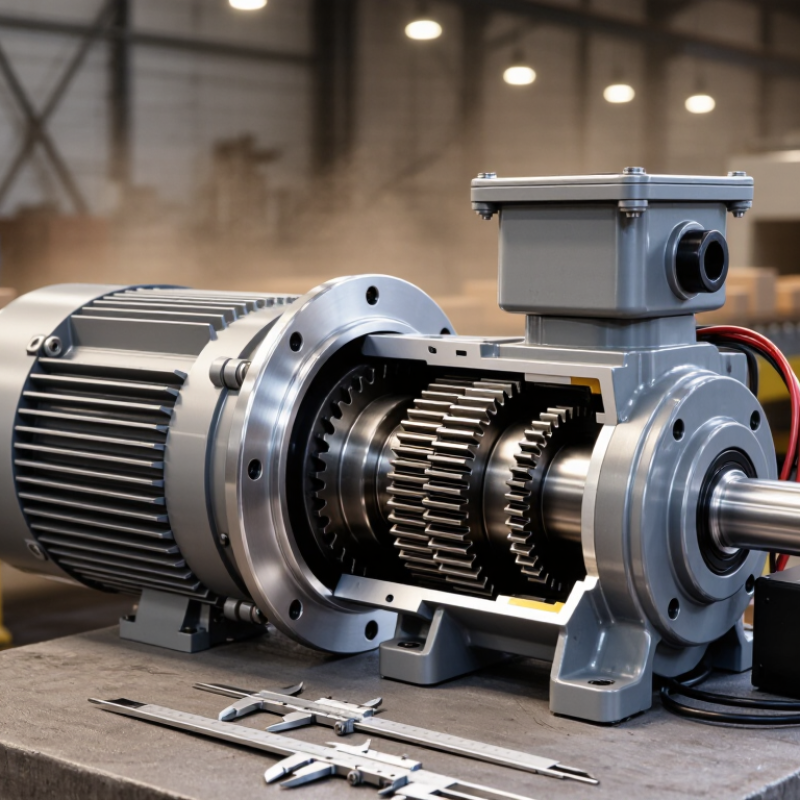
7 Tips for Choosing a Custom Gear Motor?

Define the Application Requirements for a Custom Gear Motor

7 Tips for Choosing a Custom Gear Motor

Before requesting a custom gear motor, describe the machine’s real working conditions. State required output speed, continuous torque, peak torque, and acceleration time. Include load weight, shaft orientation, and the driven mechanism’s inertia. A conveyor moving boxes differs greatly from a valve actuator. Small details matter.

Record the duty cycle honestly. Note operating hours, starts per minute, reversals, and expected service life. Mention available voltage, controller type, and speed feedback. If the motor runs in a narrow enclosure, measure heat, dust, moisture, and clearance. Temperature changes can affect lubricant performance and winding life.

Use measurements instead of hopeful estimates. A torque reading during startup may reveal twice the running load. Leave a practical service margin, but avoid excessive oversizing. An oversized motor can cost more, waste energy, and reduce control quality. The first calculation is rarely perfect. Define mechanical interfaces precisely. Provide mounting dimensions, shaft diameter, keyway details, connector position, and allowable backlash. State noise limits if the unit operates near people. Ask for drawings, test conditions, efficiency data, and tolerance values. Confirm samples under load, not only at no-load speed. Keep a record of every assumption. That record makes later revisions faster and more reliable. Yet one assumption may still fail in the field. Plan a monitored trial before approving production quantities.

Select the Gear Type, Ratio, and Motor Configuration

Choosing a custom gear motor starts with the load, not the catalog. In field projects, I measure starting torque, running torque, duty cycle, and shock loads. A conveyor may look steady, yet a jammed belt can demand several times more torque. Record shaft speed, available space, noise limits, and ambient temperature. These details shape every later decision. Sometimes, the first measurement is wrong. Recheck it.

Choose the gear type according to motion and efficiency needs. Spur gears suit simple, economical drives, while helical gears usually run more quietly. Worm gears offer high reduction in compact spaces, but efficiency and heat need careful review. Planetary designs handle high torque density, though they may cost more and require tighter manufacturing control. Select the ratio from the required output speed, then verify torque at that ratio. Do not trust a calculated ratio alone. Test acceleration and stopping behavior. A ratio that works on paper may feel sluggish under real load.

Match the motor configuration to the power source, controls, and installation method. Decide between brushed or brushless operation, encoder feedback, braking, and thermal protection. Check voltage tolerance, connector placement, shaft orientation, and mounting holes before approval. Ask for a duty-cycle test using the actual load profile. This exposes heat buildup, backlash, and unexpected noise. I also leave modest torque margin, rather than choosing an oversized motor by habit. Too much margin can reduce efficiency and increase cost. Document assumptions, because custom designs change when one assumption moves.

Match Torque, Speed, Load, and Duty Cycle

7 Tips for Choosing a Custom Gear Motor

Match torque, speed, load, and duty cycle before discussing housing size or mounting details. Tip 1: Measure the real load, not the advertised load. Include friction, acceleration, and starting resistance. Tip 2: Calculate continuous and peak torque separately. A motor may survive a brief surge but overheat during repeated starts. Tip 3: Set the required output speed at the gearbox shaft. Small speed errors can affect indexing, feeding, or product spacing.

Tip 4: Check the load pattern carefully. Continuous, intermittent, reversing, and shock loads require different designs. Tip 5: Review the duty cycle in minutes per hour. Heat has nowhere to hide inside a compact enclosure. My early estimates were too optimistic because I ignored frequent stops. That mistake increased temperature quickly. Tip 6: Leave a practical service margin, but avoid excessive oversizing. A larger motor can raise cost, noise, and energy use.

Tip 7: Confirm shaft loads, mounting direction, and environmental conditions with the manufacturer’s engineers. Dust, moisture, washdown exposure, and ambient heat may change the recommended sealing and materials. Ask for test data at your actual torque and speed. A spreadsheet helps, but it can still mislead. Record measured current, temperature, and vibration during trials. Those details often reveal an unsuitable ratio before production begins.

7 Tips for Choosing a Custom Gear Motor: Match Torque, Speed, Load, and Duty Cycle

Tip Selection Dimension What to Confirm Practical Calculation or Target Example Requirement Common Risk
1 Define the Load Identify the moving mass, friction, incline angle, pulley or sprocket size, acceleration, and external resistance. For a linear drive, estimate force from rolling resistance, incline force, and acceleration force. Convert force to shaft torque using T = F × r. A conveyor moves a 50 kg load with a 0.05 m drive roller and requires an estimated 12 N·m running torque. Underestimating starting or incline resistance can cause stalling.
2 Match Continuous and Peak Torque Separate normal running torque from breakaway, acceleration, impact, and jam-clearing torque. Choose a motor and gearbox whose continuous rating exceeds the running requirement and whose peak capability covers short-duration demand. Required running torque: 12 N·m. Required acceleration torque: 20 N·m for 2 seconds. A suitable design must support both values. Sizing only for average torque may result in overheating or failure during startup.
3 Select the Required Speed Specify output speed, acceptable speed variation, acceleration time, and whether variable-speed control is required. For a rotary load, use n = v ÷ (2πr) when converting linear speed to rotational speed. Select a gear ratio that keeps motor speed within its efficient operating range. A 0.05 m radius roller operating at 0.5 m/s requires approximately 95 rpm at the roller. Excessive reduction may reduce efficiency, while insufficient reduction may leave inadequate torque.
4 Check Duty Cycle Record operating time, rest time, starts per hour, reversing frequency, and the percentage of time at peak load. Duty cycle percentage = operating time ÷ total cycle time × 100. Use intermittent-duty sizing when operation is periodic and continuous-duty sizing when operation is uninterrupted. The motor runs for 30 seconds and rests for 30 seconds, producing a 50% duty cycle and 30 starts per hour. Frequent starts, stops, or reversals can produce more heat than steady operation.
5 Choose the Gearbox Type and Ratio Compare required ratio, backlash, efficiency, shock loading, permissible radial and axial loads, and available mounting space. Approximate output torque is motor torque × gear ratio × efficiency. Real performance must also account for service factor and transient loads. A 0.25 N·m motor with a 40:1 gearbox operating at 80% efficiency produces approximately 8 N·m before applying a service margin. Ignoring gearbox efficiency or allowable shaft loads can lead to inadequate output or premature wear.
6 Verify Electrical and Control Requirements Confirm voltage, current limit, controller type, feedback method, braking, direction changes, and available power supply capacity. Allow for startup current and controller overhead. For a DC system, approximate input power using P = V × I; actual motor power depends on efficiency and operating point. A 24 V motion system must accommodate the motor's rated current plus temporary acceleration current without triggering protection. An undersized power supply or incompatible controller may cause resets, poor speed regulation, or missed position commands.
7 Account for Environment, Size, and Safety Margin Review temperature, dust, moisture, washdown exposure, installation orientation, noise limits, dimensions, shaft configuration, and maintenance access. Apply a documented service factor appropriate to shock and duty conditions rather than selecting an arbitrarily oversized motor. Confirm enclosure and insulation requirements for the installation environment. An outdoor actuator may require corrosion-resistant construction, sealed bearings, suitable ingress protection, and operation across a defined ambient temperature range. Poor environmental protection, excessive oversizing, or inadequate clearance can reduce service life and increase cost.
Quick Selection Checklist: Confirm load torque, peak torque, output speed, gear ratio, duty cycle, starts per hour, electrical supply, controller compatibility, mounting dimensions, shaft loads, operating environment, and the required service margin before finalizing a custom gear motor.

Evaluate Materials, Size, Efficiency, and Operating Conditions

Tip 1: Inspect the gear motor’s materials before comparing prices. Hardened steel gears usually tolerate repeated loads, while reinforced polymers can reduce noise and weight. Ask about shaft material, housing protection, and bearing quality. A bright finish does not always mean better durability.

Tip 2: Match the motor size to the available space and required torque. Measure mounting holes, shaft diameter, and gearbox length before ordering. Tip 3: Check efficiency at your real operating speed, not only the published peak value. A motor may perform well on paper but lose energy under heat, friction, or frequent starts. In my experience, a small efficiency difference becomes noticeable in equipment running all day. Tip 4: Calculate the starting torque carefully. Conveyor loads, lifting mechanisms, and machines with high inertia need extra capacity. Undersizing is a costly mistake.

Tip 5: Review operating conditions in detail. Temperature, dust, moisture, vibration, and duty cycle can change the correct specification. Tip 6: Confirm voltage, current, speed range, and control compatibility with the existing system. Electrical mismatches create unstable performance and premature wear. Tip 7: Request testing data or a sample when the application is critical. A short bench test can reveal noise, backlash, and heat buildup. Some assumptions will be wrong. That is useful. Record measured torque, surface temperature, and sound levels before approving the final custom gear motor.

Choosing a Custom Gear Motor: Typical Gearbox Efficiency

Efficiency is one of the key factors when selecting a custom gear motor. The typical ranges below show how gearbox design can influence energy use, heat generation, and required motor power. Actual performance varies with gear ratio, load, lubrication, speed, and operating conditions.

Selection tip: Evaluate efficiency together with required torque, available installation space, duty cycle, ambient temperature, shock loads, noise limits, and maintenance requirements.

Confirm Customization, Testing, Quality, and Supplier Support

Choosing a Custom Gear Motor: 7 Practical Tips

A custom gear motor should fit your application, not force your design to change. Confirm torque, speed, voltage, duty cycle, shaft size, mounting holes, and operating temperature. Ask for a drawing with tolerances. Small errors can create costly assembly problems. Also discuss gear material, lubrication, noise limits, and protection requirements. The motor must survive real conditions, including dust, vibration, and repeated starts.

Request a prototype before approving volume production. Test it under actual load, not only on a workbench. Measure startup current, running temperature, output speed, backlash, noise, and vibration. Testing should cover overloads and long operating cycles. Ask for recorded data, test methods, and acceptance limits. A polished report is useful, but raw measurements reveal more. I have seen motors pass short tests and overheat during extended operation. That mistake is easy to miss.

Quality control needs traceability. Check incoming material records, process inspections, final testing, and serial-number tracking. Confirm that critical dimensions remain consistent between samples and production units. Supplier support matters just as much. A capable supplier should answer engineering questions, review installation details, and explain corrective actions clearly. Discuss spare parts, lead times, warranty terms, and design changes early. Some suppliers promise flexibility but respond slowly after the purchase order. That warning deserves attention. Keep communication documented, especially when performance requirements change.

FAQS

What information should I collect before choosing a custom gear motor?

Measure starting torque, running torque, speed, duty cycle, and shock loads. Record available space, noise limits, and temperature. Recheck measurements. A wrong reading can distort every later decision.

How do I choose between spur, helical, worm, and planetary gears?

Spur gears suit simple, economical drives. Helical gears usually reduce operating noise. Worm gears provide high reduction in compact spaces but may create more heat. Planetary gears handle high torque density and often require tighter manufacturing control.

How should I select the gear ratio?

Start with the required output speed. Then verify torque, acceleration, and stopping behavior at that ratio. A calculated ratio may look correct but feel sluggish under load.

Which motor configuration details need confirmation?

Check the power source, control system, voltage tolerance, and installation method. Decide whether brushed or brushless operation fits the application. Consider encoder feedback, braking, thermal protection, connector placement, and shaft orientation.

How much torque margin should a custom gear motor have?

Leave a modest margin for starting loads and sudden resistance. Too little capacity may cause failure. Too much margin can increase cost, size, and energy use. Bigger is not automatically better.

Which materials and mechanical parts deserve close inspection?

Hardened steel gears usually tolerate repeated loads. Reinforced polymers may reduce noise and weight. Inspect the shaft, housing protection, and bearings. A bright surface finish proves little by itself.

How can I confirm the motor fits the equipment?

Measure the mounting holes, shaft diameter, shaft orientation, and gearbox length. Check connector location and surrounding clearance. A small dimensional error can stop installation completely.

Why should efficiency be tested at the actual operating speed?

Published peak efficiency may not match real performance. Heat, friction, frequent starts, and heavy loads can reduce efficiency. A motor running all day reveals small losses clearly.

What operating conditions can change the final specification?

Temperature, dust, moisture, vibration, and duty cycle all matter. Confirm voltage, current, speed range, and control compatibility. Electrical mismatches may create unstable operation and early wear.

What should a final application test measure?

Test the motor with the actual load profile when possible. Record torque, surface temperature, noise, backlash, and heat buildup. A short bench test can expose hidden problems. Some assumptions will be wrong. That is useful.

Conclusion

Choosing the right Custom Gear Motor begins with a clear understanding of the application. Define the required movement, operating environment, available space, mounting method, and expected service life before selecting components. Then determine the most suitable gear type, reduction ratio, and motor configuration. Carefully match the motor’s torque and speed to the load, while considering starting conditions, acceleration, reversing, and duty cycle to ensure reliable performance.

Material selection, overall dimensions, efficiency, noise, heat dissipation, and resistance to dust, moisture, or chemicals should also be evaluated. A successful solution may require adjustments to the shaft, housing, wiring, mounting features, or control method. Before final approval, confirm the supplier’s customization capabilities, testing procedures, quality controls, documentation, and after-sales support. A thorough evaluation helps ensure the Custom Gear Motor delivers stable operation, efficient power transmission, and dependable long-term performance in its intended application.

Charlotte

Charlotte

Charlotte is a seasoned marketing professional with a deep understanding of the company's portfolio and a passion for elevating its presence in the market. With a keen eye for detail and a commitment to excellence, she ensures that our professional blog is regularly updated with insightful articles......